
OpenAI is reportedly racing to roll out GPT‑5.2 this week. CEO Sam Altman issued an internal “code red” directive. The company is scrambling to close the performance gap with Google’s Gemini models.
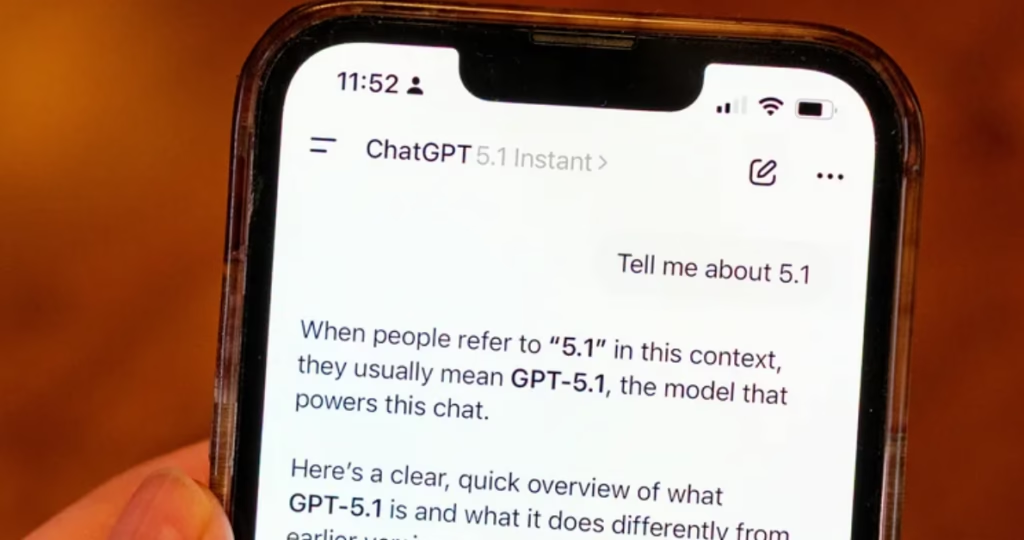
What GPT‑5.2 is expected to bring
According to reports citing The Wall Street Journal, GPT‑5.2 is being fast‑tracked as a frontier update for ChatGPT, with a particular focus on:
- Stronger coding capabilities and tools for developers
- Enterprise‑oriented improvements, likely around reliability, security, and integration features
The model was originally planned for later in December. However, it has been pulled forward after Altman’s code red memo. Some employees reportedly wanted more time to refine it. Internal evaluations suggest GPT‑5.2 is already competitive with or ahead of Google’s Gemini 3 on certain reasoning benchmarks, which is a key motivation for the accelerated schedule.
Code red: focus on ChatGPT, pause on side projects
Altman’s “code red” order instructed staff to prioritise ChatGPT quality above almost everything else, delaying or pausing non‑core efforts such as ad experiments, some AI agent projects, and other new features. The goal is to improve:
- Speed and latency
- Reliability and stability
- Everyday usefulness for mainstream users, not just benchmark scores
The strategy also leans heavily on user signals like one‑click feedback and output comparisons, which have previously influenced model behaviour (including some of the “sycophancy” issues seen with GPT‑4o). Altman has also highlighted LMArena, a crowdsourced model‑ranking platform, noting that models that rank well there tend to be popular with users, so performance on such public benchmarks is now a high priority.
Another new model planned for January
The code red push will not end with GPT‑5.2. Altman has indicated that a second major model release is planned for January, after which the emergency phase is expected to wind down. This follow‑up model is rumoured to offer:
- Stronger image generation and multimodal abilities
- A more engaging “personality,” closer to GPT‑4o’s style
- Lower latency than the current frontier model, aimed at smoother real‑time use
Until both models are out, OpenAI is expected to keep most non‑ChatGPT projects on hold to keep resources concentrated on this two‑stage response to Google’s Gemini 3.
Tensions inside OpenAI over direction
Reports suggest the code red has sharpened internal tensions between:
- Product‑focused teams (led by executives like Applications CEO Fidji Simo and CFO Sarah Friar), who want more investment in user experience, speed, and practical value in ChatGPT; and
- AGI research teams, who favour pushing ahead on advanced reasoning and long‑term AGI work, even if that means less emphasis on incremental UX upgrades.
Product leaders argue that many users still have not fully tapped existing features and that OpenAI must make ChatGPT tangibly better right now to defend market share, especially as Gemini gains traction. Researchers, meanwhile, worry that an intense short‑term competitive sprint could distract from deeper advances toward artificial general intelligence.
What this means for users and the AI race
If timelines hold, users could see GPT‑5.2 arrive in ChatGPT and the API within days, bringing better reasoning, coding help, and enterprise features, followed a few weeks later by a more visually capable, faster model in January. For everyday users, that likely means:
- More accurate answers and fewer obvious mistakes
- Snappier responses, especially under heavy load
- Richer multimodal experiences once the January model lands
More broadly, the code red episode underlines how intense the OpenAI–Google competition has become: both sides are accelerating release schedules, using public benchmarks and user metrics as scoreboards, and reshaping internal priorities around flagship chat products.