In the high-stakes world of Artificial Intelligence (AI) and semiconductor innovation, the relationship between competitors is often seen as a zero-sum game. Yet, a recent statement from the head of one of the industry’s most dominant firms, Nvidia CEO Jensen Huang, has complicated this narrative, offering a rare public salute to a fierce rival: China’s Huawei.
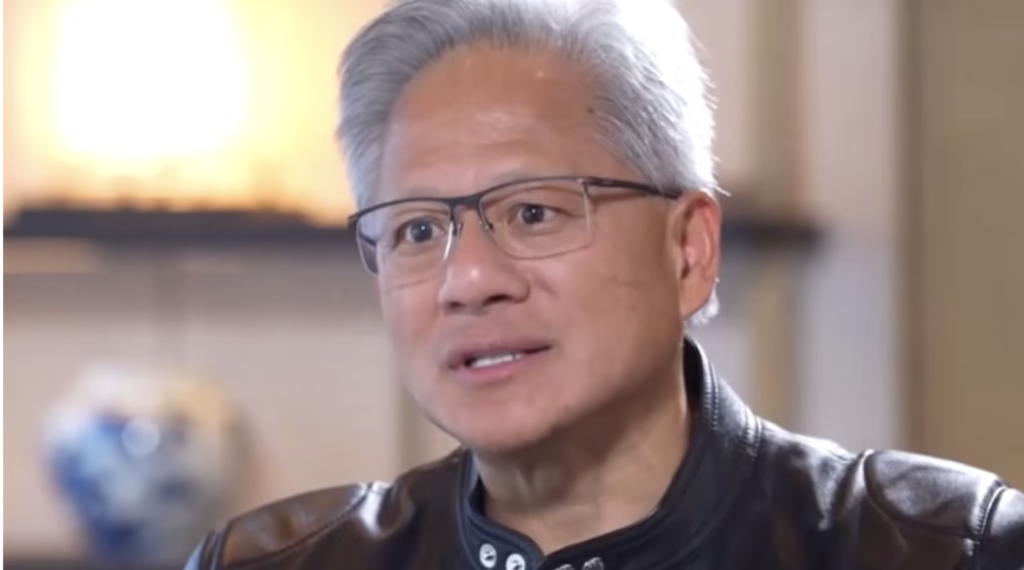
Speaking at the Center for Strategic and International Studies (CSIS) event in the U.S. on December 3, Huang did not mince words, calling Huawei one of the “most powerful firms in history” and stressing that the company is worthy of genuine respect, even amid intense competition.
Acknowledging a Titan
Huang’s comments come at a time when geopolitical tensions often overshadow technological collaboration, particularly concerning U.S. and Chinese technology giants. Despite this tense landscape, the Nvidia CEO offered an unvarnished assessment of his counterpart’s capabilities.
“Huawei is not only highly innovative but also a company of extraordinary scale and strength,” Huang stated, emphasizing that Huawei’s prowess goes beyond mere size. “Huawei is much larger than us; in terms of company size, personnel size, and technological capabilities. It’s both deep and broad.”
He went on to urge the audience to appreciate the depth of Huawei’s engineering, noting, “Anyone who has carefully examined a Huawei phone will understand the technological marvels it embodies.”
The AI Chip Race: Competitor, Not Enemy
The core of the competitive dynamic lies in the rapidly evolving field of AI chip technology, where both Nvidia and Huawei are pouring vast resources into developing next-generation accelerators. Huawei’s Ascend series, particularly the Ascend 910 AI processor, has been positioned as a direct challenger to Nvidia’s industry-leading GPUs.1
When asked by the media whether he views Huawei as a competitor or a partner, Huang affirmed the rivalry but immediately drew a crucial distinction.
“It is our rival, but we can still admire and respect them, maintaining good relations. Competitors are not enemies. The world is vast, and I hope we can continue to compete for many years to come, but my feelings towards them are admiration, respect, and a strong competitive spirit.”
This perspective suggests a mature understanding that global innovation thrives on healthy, aggressive competition.
Strength in Depth: Design and Software
Huang specifically highlighted areas where Huawei has demonstrated “outstanding” capabilities, notably in autonomous driving and sophisticated AI technology. He credited the firm with possessing a difficult-to-replicate combination of expertise: strong AI chipset design, robust system design, and advanced system software.
The CEO’s recognition underscores a key industry truth: even as U.S. sanctions have placed pressure on Huawei’s access to certain technologies, the company’s internal research and development has continued to produce world-class innovations.
In conclusion, Jensen Huang’s frank admiration for Huawei serves as a powerful reminder: the technological landscape is defined not just by rivalry, but by the acknowledgement of greatness—even across adversarial lines. For the future of AI, this competition promises to drive both companies to even greater heights.
Also Read: TCS Partners With TPG in ₹18,000-Crore Push to Build India’s Next-Gen AI Data Centres