For much of the last decade, Stack Overflow functioned as critical infrastructure for the global software industry. It was not merely a discussion forum, but a high-efficiency marketplace for technical knowledge matching developer questions with expert answers at internet scale.
New data now suggests that this marketplace is undergoing a prolonged structural contraction, rather than a temporary cyclical slowdown.
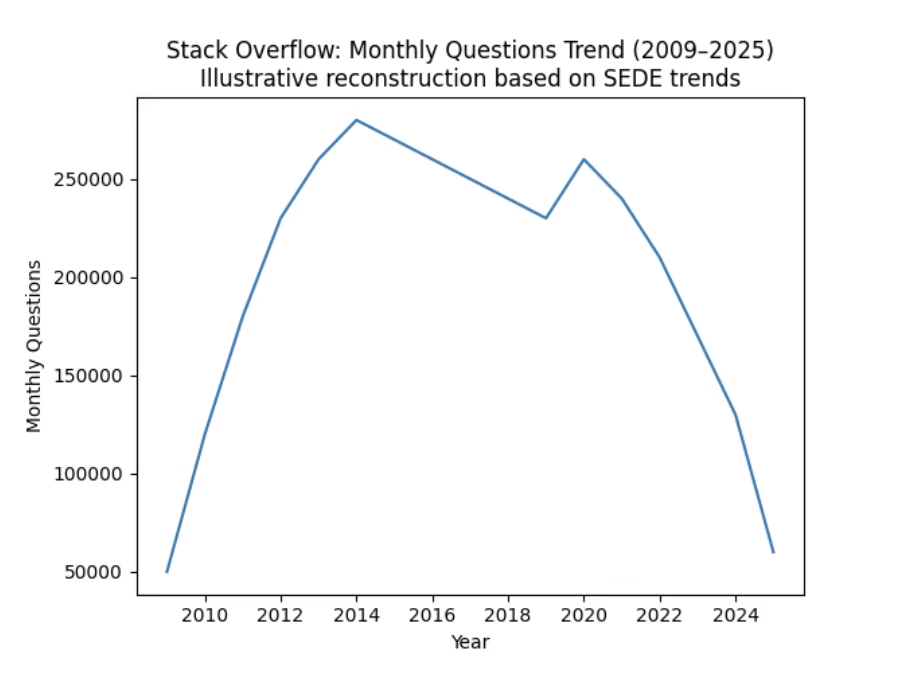
Question Volume Falls Back to 2009 Levels
A Decline That Began Long Before AI
The data indicates that the downturn did not begin with generative AI.
2014: Moderation as a Structural Break
The initial decline coincides with a significant tightening of moderation policies. During this period:
- Question closure rates increased
- Duplicate detection became more aggressive
- Low-quality filters were expanded
From an economic standpoint, this raised the cost of participation for question askers. While moderation efficiency improved, user friction increased—reducing demand at the margin, particularly among newer developers.
2020: A Temporary Pandemic-Driven Reversal
In early 2020, Stack Overflow experienced a sharp but temporary increase in traffic and engagement.
Lockdowns and the shift to remote work changed developer behavior:
- Informal, in-office problem solving declined
- Developers increasingly relied on search engines
- Stack Overflow benefited as a downstream recipient of Google traffic
However, this surge proved transitory.
By mid-2020, question volume resumed its downward trajectory at a faster rate than before.
Ownership Change and Incentive Realignment
In June 2021, Stack Overflow was acquired for $1.8 billion by private-equity-backed Prosus. In hindsight, the transaction occurred close to peak enterprise value.
From a platform-economics perspective, this marked a shift:
- Growth expectations were decoupled from organic community expansion
- Monetization priorities became more prominent
- Contributor incentives remained largely unchanged
The result was a widening mismatch between value extraction and value creation.
2022: AI as a Technological Substitute
The most decisive inflection point arrives in late 2022 with the public release of ChatGPT.
The economic implications were immediate:
- AI tools reduced the time cost of getting answers
- Responses became conversational, polite, and unconditional
- The output quality closely mirrored Stack Overflow answers—unsurprising, given training data sources
Within months, Stack Overflow’s question volume began to fall sharply.
In effect, generative AI acted as a direct substitute good—delivering similar utility at a lower user cost.
Supply-Side Effects: Why Experts Contribute Less
Stack Overflow’s success depended on unpaid expert labor. Contributors were compensated through:
- Reputation scores
- Professional signaling
- Community status
These incentives have weakened:
- AI systems absorb expertise without attribution
- Reputation points yield diminishing career value
- Moderation overhead discourages marginal contributions
In economic terms, the platform is experiencing a supply contraction alongside falling demand.
Is This Terminal Decline?
By May 2025, monthly questions had fallen to roughly the same level as at launch.
From a market perspective, the remaining uncertainty is not whether Stack Overflow will shrink further—but how it will be repositioned:
- As a static archival database
- As a niche professional reference
- Or as an asset divested at a substantially lower valuation
Absent a fundamental redesign of incentives or integration with AI-native workflows, continued decline appears likely.
Broader Implications for the Software Industry
Stack Overflow’s trajectory reflects a larger shift in how technical knowledge is produced and consumed:
- Knowledge is becoming privatized
Answers increasingly reside inside proprietary AI systems. - Public contribution is less economically rational
Open knowledge creation lacks sufficient incentives. - Developer communities are fragmenting
Interaction is moving to Discord servers, Slack groups, and closed forums.
A Platform That Shaped a Generation
Stack Overflow’s decline marks the end of a defining phase in software development. For years, it transformed problem-solving into a global, gamified collaboration—helping millions of developers overcome technical barriers.
While its operational future is uncertain, its historical impact is not. The platform remains one of the most significant repositories of human-generated technical knowledge ever created.
In economic terms, Stack Overflow did not fail—it was outcompeted by a lower-cost substitute, accelerated by changing incentives and technological progress.