

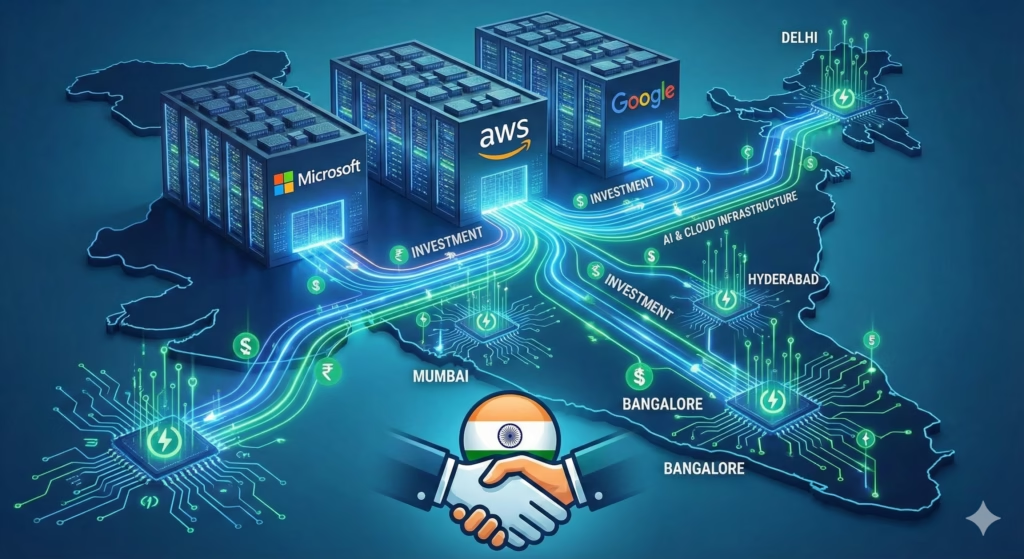
India is experiencing an unprecedented surge in artificial intelligence and cloud infrastructure investments. Tech giants are making record commitments. This signals the nation’s emergence as a critical hub in the global AI economy. In just two days alone, Microsoft announced a $17.5 billion investment and Amazon committed $35 billion, joining Google, Intel, and other major players in betting heavily on India’s AI and semiconductor ecosystem.
Microsoft’s $17.5 Billion Bet: Building the AI Backbone
Microsoft announced its largest investment in Asia—a $17.5 billion commitment spanning 2026 to 2029—following a meeting between CEO Satya Nadella and Prime Minister Narendra Modi. This investment builds on Microsoft’s earlier $3 billion AI and cloud announcement, bringing its total recent India commitment to approximately $20.5 billion.
The strategy focuses on three pillars: scale, skills, and sovereignty. Microsoft plans to construct a hyperscale cloud region in Hyderabad—essentially a cluster of AI data centres—that is set to go online by mid-2026. The company will also fund massive skilling programmes, aiming to upskill 20 million Indians by 2030 in AI, cloud, and cybersecurity capabilities.
Amazon’s Historic $35 Billion Commitment
On the heels of Microsoft’s announcement came Amazon’s $35 billion investment pledge through 2030—its largest-ever commitment to India. This money will be channelled into three key areas: AI-driven digitization, boosting exports, and creating new jobs. When combined with Amazon’s existing $40 billion in cumulative investments, the tech giant becomes the largest foreign investor in India, with nearly $75 billion committed.
Amazon already operates data centres in Telangana and Maharashtra, and this new investment will fuel massive expansion of these facilities to meet India’s growing cloud and AI infrastructure demands.
Google, Intel, and the Broader Tech Ecosystem
The AI investment wave extends far beyond Microsoft and Amazon. Google announced a $15 billion investment in October, including the development of a massive AI hub in Vishakhapatnam. Meanwhile, Intel has partnered with Tata’s semiconductor arm in a landmark deal, with Tata investing $14 billion to establish India’s first semiconductor fabrication facility in Gujarat and an assembly line in Assam.
Intel’s CEO met with Prime Minister Modi to pledge support for India’s semiconductor mission, which itself has $8 billion in government funding. Collectively, these announcements signal a total of over $100 billion in AI, cloud, and semiconductor investments flowing into India over the next 3-5 years.
Why India? Three Converging Factors
1. A Massive, Diverse Consumer Base
India boasts over 1 billion mobile phone users who speak different languages, follow diverse cultures, and represent varied use cases. For AI developers and companies, India is the ultimate testing ground—if an AI model works for India’s complex, multilingual, multicultural environment, it can succeed globally.
2. Government Support and AI Adoption
The Indian government is not hostile to AI; it is actively nurturing the sector. The nation has launched a dedicated semiconductor mission with $8 billion in funding and is integrating AI into public services at scale. This creates an AI-friendly regulatory environment and massive domestic demand for AI-driven solutions.
3. Geopolitical Shifts and Risk Mitigation
US technology firms are increasingly wary of investing in China due to geopolitical tensions. India represents a safer alternative—a stable democracy with abundant English-speaking engineers, a huge market opportunity, and a free-society ecosystem that aligns with Western values. From a supply-chain perspective, tech companies are diversifying away from China, and India is a prime beneficiary.
Tangible Benefits for Indians: Jobs, Skills, and Leverage
Employment Generation
These investments promise substantial job creation. Microsoft alone is committing to upskill 20 million Indians by 2030, equipping them with in-demand AI and cloud skills. Amazon has already supported 2.8 million direct and indirect jobs in India and is positioned to add more through its $35 billion investment.
Data Sovereignty and Strategic Leverage
Beyond jobs and infrastructure, these investments offer India a crucial strategic advantage: data sovereignty. Historically, Indian data has been stored and processed in data centres abroad—in California, Texas, or other US locations. Microsoft’s sovereign cloud services allow Indian data to remain within the country. This aligns with Indian regulations and governance.
This shift provides India with greater leverage in global tech negotiations. By becoming part of the AI supply chain, India gains negotiating power. India has influence over the rules and standards governing AI development, rather than merely consuming foreign AI services.
Challenges Ahead
While the investment tsunami is positive, India faces real challenges:
- Infrastructure demands: Hyperscale AI data centres require massive power and cooling infrastructure, straining India’s energy grid in certain regions.
- Talent gaps: While India has skilled engineers, the need to upskill 20+ million people in advanced AI is a monumental task.
- Regulatory clarity: India’s AI governance framework is still evolving; clearer rules around data, privacy, and AI ethics will be essential.
- Geopolitical risks: If US-China tensions escalate further, India’s role as a neutral alternative could be tested.
The Bigger Picture: From Consumer to Producer
Historically, India has been a consumer of foreign technology. These $100+ billion investments represent a paradigm shift. India is becoming a producer and hub in the global AI supply chain. India is hosting data centres. It is training millions of AI professionals. Additionally, it is building semiconductor fabrication facilities. Through these efforts, India is moving up the value chain.
The real question is not whether India will benefit from these investments—it clearly will. The question is whether India will use this newfound leverage wisely. Will it advocate for fair AI policies globally? Will it protect user privacy? Will it ensure that AI development benefits all Indians, not just a select few?
Prime Minister Modi’s comment that this investment is “not a one-off” underscores India’s rising importance in the global tech ecosystem. The next few years will show if India can transform these capital inflows into sustainable and inclusive growth. It will also test if India can achieve genuine technological sovereignty.