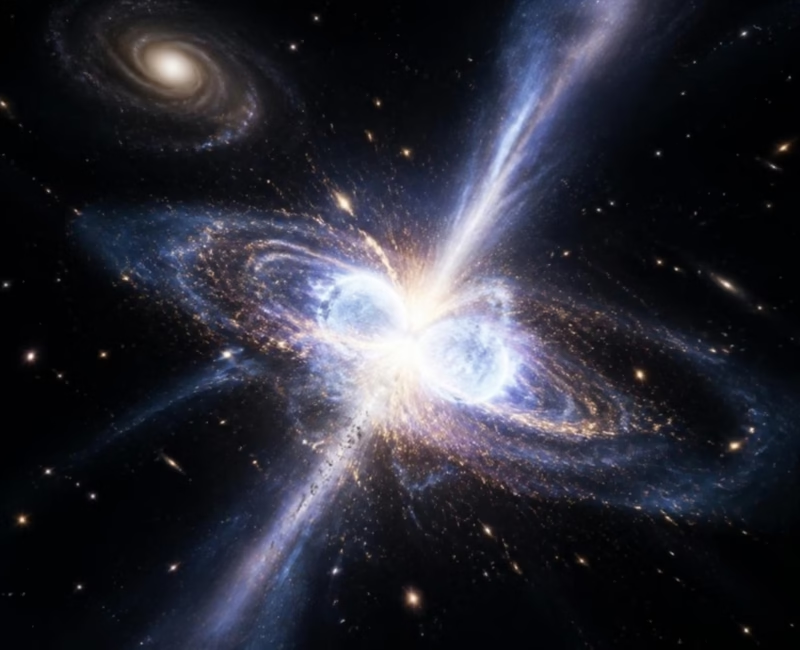
Somewhere far across the universe, two dead stars may have smashed into each other. The flash of light from that crash traveled for about 6 billion years before reaching Earth. Now, astronomers think this neutron star collision produced the longest X-ray flash ever linked to such an event. Let’s break it down in simple words.
⚡ Quick Facts
- Event name: EP250704a, first seen on 4 July 2025
- What: A half-second gamma-ray burst, then about 10 minutes of X-rays
- Spotted by: The Einstein Probe, a European-Chinese X-ray mission
- Study: Published in Science Bulletin (2026)
What Did Astronomers See?
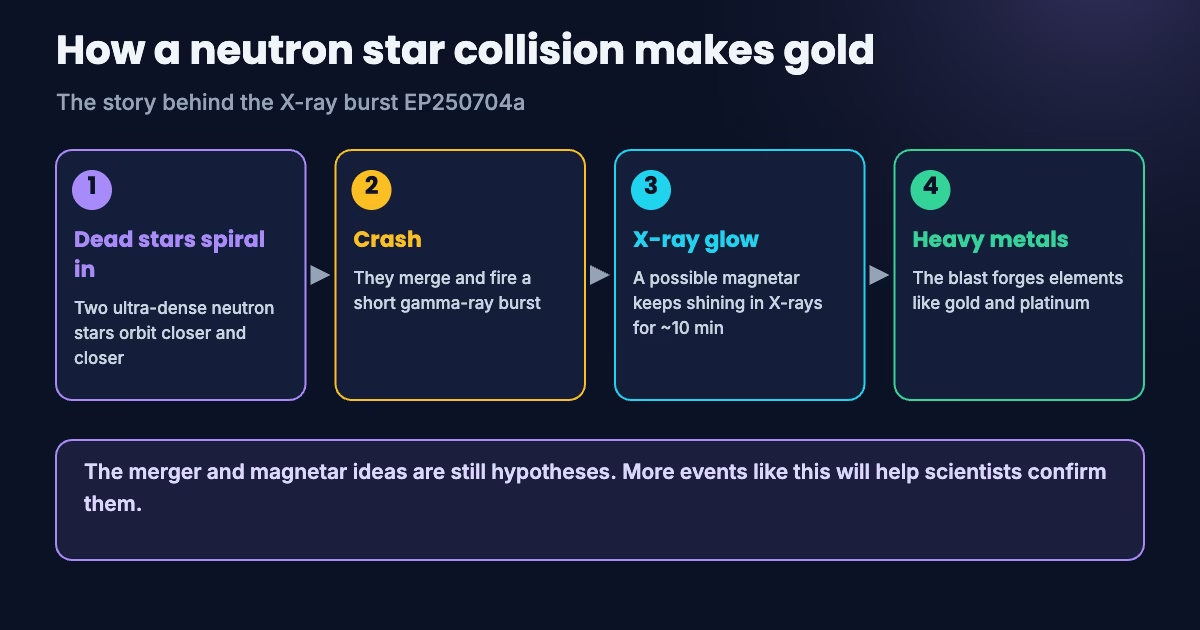
First, a very short burst of gamma rays lasted about half a second. Then, a glow of X-rays kept shining for around 10 minutes. The Einstein Probe raised the alarm, and big telescopes quickly followed up. For example, the European Southern Observatory’s Very Large Telescope (VLT) and the Very Large Array (VLA) both joined in.
Importantly, the team ruled out a supernova as the cause. That left a more exciting idea on the table.
What Is a Neutron Star Collision?
A neutron star is the leftover core of a giant star that exploded. It’s incredibly dense. In fact, a spoonful of neutron star material would weigh billions of tonnes on Earth.
Sometimes, two neutron stars orbit each other. Over millions of years, they spiral closer and finally crash together. As a result, a neutron star collision releases a huge flash of energy in just a moment.
Why Was This Neutron Star Collision Flash So Long?
Usually, these mergers are linked to gamma-ray flashes that last under two seconds. This one, however, glowed in X-rays for about 10 minutes. Researcher Niccolò Passaleva called it “the longest-lasting prompt X-ray flash ever observed from a neutron star merger.”
So, what kept it shining? The team thinks the crash may have left behind a magnetar. That’s a neutron star with an extremely strong magnetic field. According to team member Eleonora Troja, a magnetar remnant “could keep bursting for longer.”
Why a Neutron Star Collision Matters: Gold and Platinum
Here’s the coolest part. Scientists believe neutron star mergers forge many heavy elements, like gold, silver and platinum. In other words, the gold in your jewelry may have come from a cosmic crash like this one, billions of years ago.
Therefore, finding more of these events helps astronomers learn how often mergers create magnetars and heavy metals.
Is the Neutron Star Collision Confirmed?
Not fully. The merger and magnetar explanations are still hypotheses. Also, the Einstein Probe has spotted hundreds of X-ray flashes. Some come from exploding massive stars, while others, including this one, are still being studied. Still, it’s a strong clue in a fascinating cosmic mystery.
If you love space news, you’ll also enjoy my post on NASA’s historic Moon flyby splashdown.
🎮 Space Quiz: Test Your Star Power
Now, see how much you learned with five quick questions.
Key Takeaways on the Neutron Star Collision
- The X-ray burst EP250704a lasted about 10 minutes after a half-second gamma-ray flash.
- Astronomers think a neutron star collision caused it, possibly leaving a magnetar behind.
- Such mergers likely create gold, silver and platinum.
- The explanation is promising but not yet confirmed.
Frequently Asked Questions (FAQ)
1. What is the Einstein Probe?
It’s a joint European-Chinese space telescope that watches the sky for X-ray flashes.
2. What is a magnetar?
It’s a neutron star with an extremely powerful magnetic field.
3. How far away did this happen?
Its light traveled about 6 billion years to reach Earth.