Subseasonal weather forecasting looks about 2 to 6 weeks ahead. Weather apps are quite good at telling you if it will rain tomorrow, and they are decent for the next 7 to 10 days. However, ask them about the weather three or four weeks from now, and most forecasts become little better than a guess. That may be starting to change. On 14 October 2026, researchers from Microsoft Research, MIT, Harvard, the University of Toronto, ECMWF and others published a study in Nature. So, let’s break it down in simple words.
⚡ Quick Summary
- Problem: Forecasts 2 to 6 weeks ahead are the hardest, the so-called “predictability desert”
- Fix: Probabilistic Bias Correction (PBC), an AI layer that learns from past forecast mistakes
- Result: About 2× the skill of ECMWF’s AI model, better rain and temperature maps, better extremes
- Why it matters: Farmers, power grids and disaster teams get weeks of notice, which is key for India’s monsoon
What Is Subseasonal Weather Forecasting?
Weather forecasts are usually grouped by how far ahead they look. Short and medium range forecasts cover up to about 2 weeks. Seasonal forecasts cover months, such as a monsoon outlook. The middle zone, about 2 to 6 weeks ahead, is called subseasonal.
Scientists sometimes call this range a “predictability desert”. Today’s weather is too far away to guide the forecast, but slow climate signals like ocean patterns are too close to fully take over. Small model errors also grow over time, so by week three or four a forecast often drifts away from reality.
What Did the Researchers Build?
They did not build a new giant weather model. Instead, they built a lightweight correction layer called Probabilistic Bias Correction (PBC) that sits on top of existing forecast models.
Think of a friend who always says the bus comes in 10 minutes, but it usually takes 15. After a few weeks you quietly add 5 minutes to whatever they say. PBC does something similar. It studies a model’s past forecasts and past mistakes, learns the patterns in those errors, and adjusts new forecasts to fix them.
PBC combines two correction methods, Debias++ and Persistence++, and averages their results. Because it is lightweight, it does not need a supercomputer, and the researchers have released the code as open source.
How Good Are the Subseasonal Weather Forecasting Results?
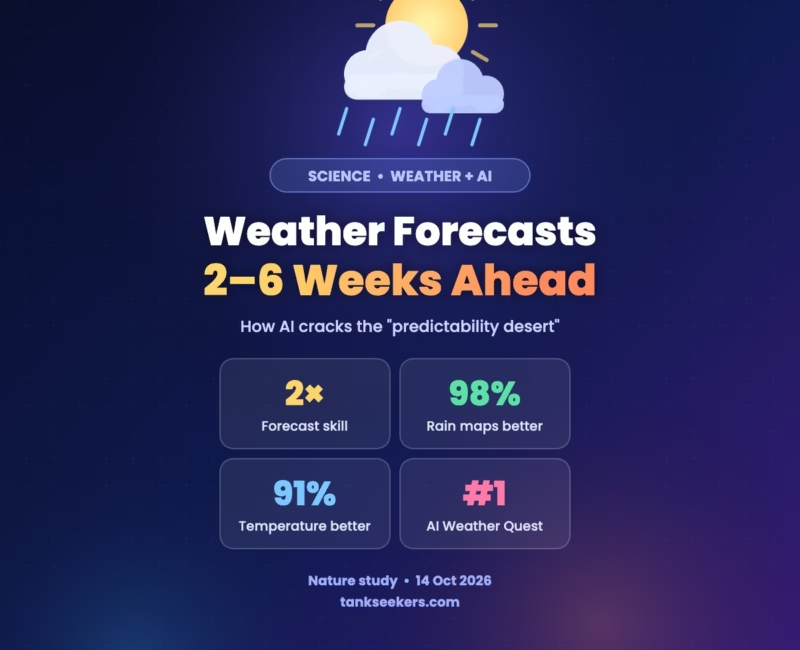
- Roughly double the skill: When applied to ECMWF’s AI-based subseasonal model, PBC about doubled its average forecast skill score.
- Better almost everywhere: On ECMWF’s physics-based model, PBC still improved precipitation forecasts at about 98% of locations and temperature forecasts at around 91 to 92%.
- Better at extremes: Flood forecast skill improved by roughly 76 to 92%. MIT News notes that ECMWF’s own non-AI correction actually got worse at extremes.
- Won a real competition: In ECMWF’s AI Weather Quest (2025), the team’s entry “MicroDuet” ranked best for every variable and lead time in the September to November season, ahead of six operational weather centres and 34 other teams.
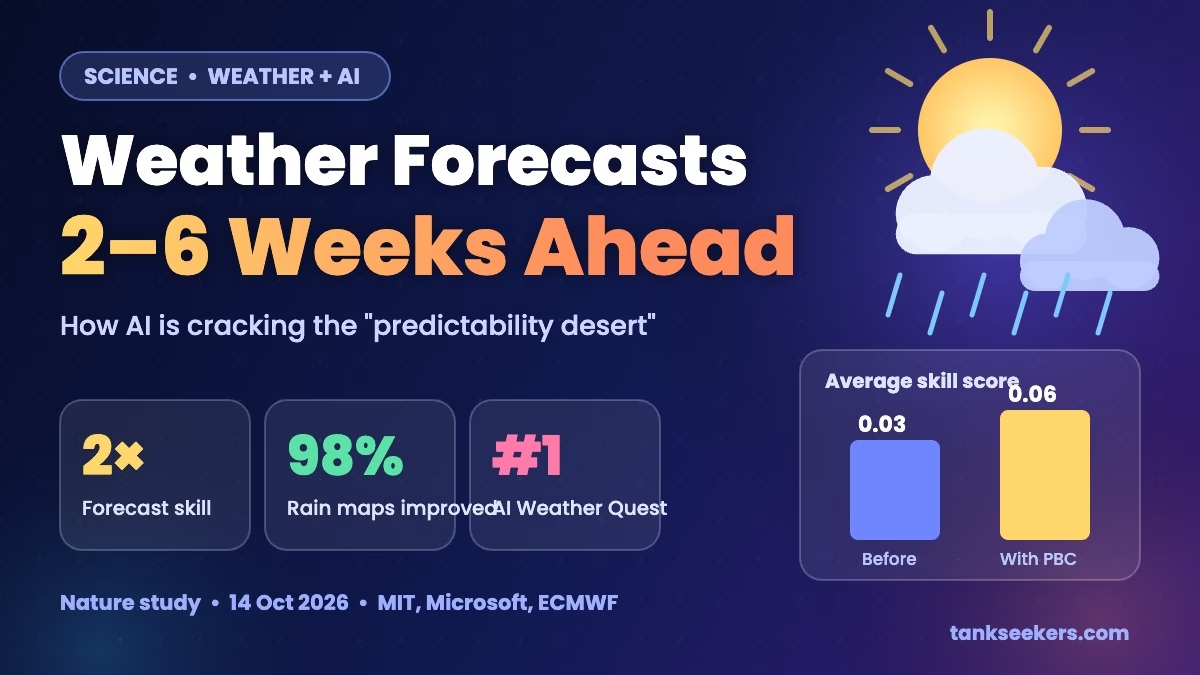
“Doubling” sounds huge, but subseasonal skill starts from a very low base. In the paper, the average skill score went from about 0.03 to about 0.06. Forecasts 3 to 4 weeks out are clearly better, but they are still probabilities, not certainties. Think “higher chance of a wetter-than-normal week”, not “it will rain at 4 pm on the 28th”.
Why Does Subseasonal Weather Forecasting Matter?
Subseasonal weather forecasting gives people the window they need to plan, not just react. MIT’s Judah Cohen, who led the work at MIT, noted that even two weeks of notice can help with energy planning and emergency preparation.
- Farmers can decide when to sow, irrigate, spray or apply fertiliser.
- Power companies can prepare for heatwaves or cold spells.
- Disaster teams can stock relief material and plan staff before floods.
- Water managers can plan dam releases and reservoir levels.
What Does Better Subseasonal Weather Forecasting Mean for India?
India is one of the countries where better 2 to 6 week forecasts could matter most. A large part of farming still depends on the monsoon, and a long “break” in the rains or a sudden heavy spell can damage crops and cause floods.
The India Meteorological Department (IMD) already runs an operational Extended Range Forecast system. Research like this shows that a low-cost AI correction layer can sharpen such forecasts without a new supercomputer. There is no announcement that IMD will adopt this exact tool, but it signals where weather science is heading. MIT News also notes that Kenya’s weather office has shown interest in using it for monsoon forecasting. For more explainers like this, browse our Science news and explainers on Tank Seekers.
Important Facts for UPSC and Other Exams
🎯 UPSC Prelims Quick Facts
- Published: 14 October 2026, journal Nature
- Method: Probabilistic Bias Correction (PBC): a post-processing layer made of
Debias++andPersistence++, not a new weather model - Range: Subseasonal = about 2 to 6 weeks (medium range = up to about 2 weeks; seasonal = months)
- Skill: Average score about 0.03 → 0.06 (roughly 2×)
- Coverage: Precipitation better at about 98% of locations; temperature at about 91 to 92%
- Competition: ECMWF AI Weather Quest (2025), winning entry “MicroDuet”
- Institutions: Microsoft Research, MIT, Harvard, University of Toronto, ECMWF, DTN, IMPA (Brazil)
- Open source: Code released, lightweight, no supercomputer needed
| Term | What to remember |
|---|---|
| ECMWF | European Centre for Medium-Range Weather Forecasts, an independent intergovernmental organisation set up in 1975, with its headquarters in Reading (UK) and a data centre in Bologna (Italy) |
| IMD | India Meteorological Department, under the Ministry of Earth Sciences, runs the Extended Range Forecast system |
| Mission Mausam | Indian government mission to upgrade weather and climate services and forecasting accuracy (background fact) |
| MJO | Madden-Julian Oscillation, a 30 to 60 day tropical cycle that is a key source of subseasonal predictability (background fact) |
| Monsoon break | A pause in monsoon rainfall during the season, which makes weeks-ahead forecasts valuable for farmers |
✍️ Mains Answer Points (GS-III: Science and Tech, Disaster Management, Agriculture)
- Intro: Subseasonal forecasts (2 to 6 weeks) fill the gap between weather and climate forecasts
- Benefits: Better sowing and irrigation decisions, power load planning, early flood and heatwave preparedness
- Challenges: Probabilistic outputs, dependence on good base models, need for validation and training of agencies
- Way forward: Test open-source tools on IMD models, invest in data and computing, build last-mile advisories for farmers
Possible prelims-style statements (tap to open)
1. Subseasonal forecasts cover about 2 to 6 weeks. Correct.
2. PBC is a new weather model that replaces physics-based models. Incorrect, it is a correction layer.
3. The AI Weather Quest is run by ECMWF. Correct.
Exams where this can help (tap to open)
UPSC Prelims and Mains (Science and Tech, Geography, Disaster Management), State PSCs, SSC, banking exam general awareness, and current affairs sections of NDA and CDS.
Test Yourself: Quick Quiz
Limitations to Keep in Mind
- Subseasonal weather forecasting still deals in probabilities, so long-range forecasts will sometimes be wrong.
- The paper reports gains for “most” targets and regions, not every single place.
- PBC depends on good underlying models. It corrects forecasts; it does not replace the physics.
- Real-world use by national weather agencies still needs testing, validation and training.
Key Takeaways
- Subseasonal weather forecasting (2 to 6 weeks ahead) is one of the hardest problems in weather science.
- PBC, built by Microsoft, MIT and partners, learns from past forecast mistakes.
- It roughly doubled the skill of ECMWF’s AI subseasonal model and improved extreme-weather forecasts.
- Its entry “MicroDuet” topped ECMWF’s AI Weather Quest competition.
- It is open source and lightweight, which makes it interesting for countries like India.
Frequently Asked Questions
What is subseasonal weather forecasting?
It means forecasting weather about 2 to 6 weeks ahead, between normal daily forecasts and seasonal outlooks.
Who developed this AI method?
Researchers from Microsoft Research, MIT, Harvard, the University of Toronto, ECMWF, DTN and Brazil’s IMPA. The study was published in Nature on 14 October 2026.
Is this a new weather model?
Not exactly. It is a correction layer that improves the output of existing models by learning from their past errors.
What is the AI Weather Quest?
A real-time competition run by ECMWF in which teams submit weekly AI-based forecasts for temperature, rainfall and pressure several weeks ahead.
Will my weather app become accurate for next month?
Not overnight. The gains are real, but forecasts 3 to 4 weeks out will still be about chances and trends, not exact daily weather.
Is the code free to use?
The researchers say it is open source and low cost to run. Check the paper’s code availability section for the exact licence.
Sources
- Nature: Advancing subseasonal forecasting with machine learning
- MIT News: Researchers improve weather forecasts looking two to six weeks out
- ECMWF: AI Weather Quest
- arXiv: Advancing Subseasonal Forecasting with Machine Learning (preprint)
- MAUSAM (IMD): Evolution of operational extended range forecast system of IMD