
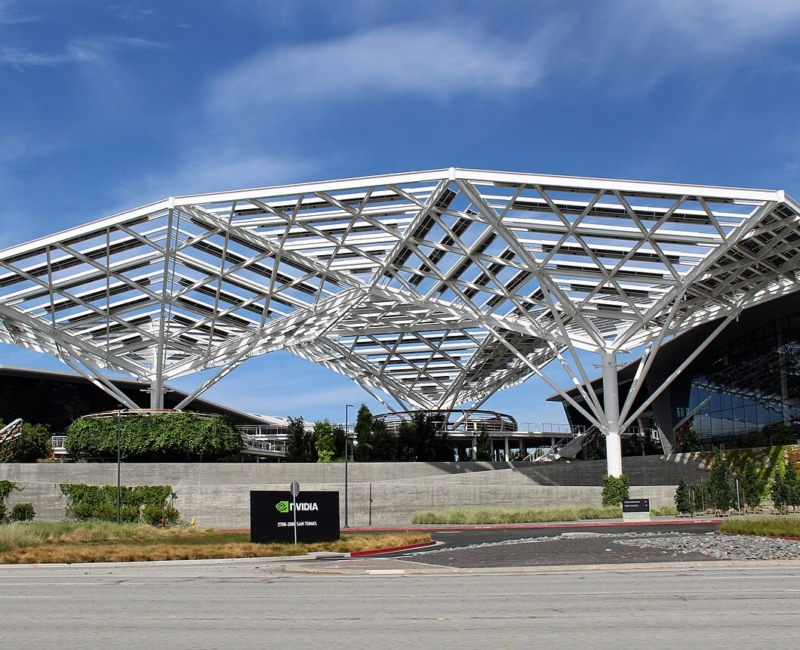
The AI stock sell-off made last week one of the roughest for technology stocks in years. In the US, the Nasdaq fell about 10% in five days, and Nvidia, the company that makes the chips behind most AI systems, lost nearly a quarter of its share price. Yet in India, the Sensex and Nifty actually ended the week higher.
So what happened? Is the “AI bubble” bursting? And why did Indian markets hold up? Let’s break it down in simple words.
⚡ Quick summary: AI stock sell-off
- US tech stocks had their worst week in years; the Nasdaq fell about 10% and Nvidia about 23%.
- Main reasons: Jensen Huang’s exit as Nvidia CEO, the record Anthropic IPO, AI bubble and debt worries, and rate and policy fears.
- Indian markets rose about 2.6–2.9% for the week as money moved away from AI-heavy markets.
- Indian IT stocks were mixed because they depend on US clients.
- Whether this is a bubble bursting or a healthy correction is still unclear.
What happened in the AI stock sell-off last week?
Here are the main numbers for the week ending Friday, 20 November 2026, based on Yahoo Finance and Marketcalls:
- Nasdaq Composite: down about 10% for the week. On Friday alone it fell 5.28% and wiped out all its gains for 2026.
- S&P 500: down about 8.6% for the week, with seven losing sessions in a row. It closed Friday at 6,910.39.
- Dow Jones: down about 8% for the week.
- Correction: both the Dow and the S&P 500 officially entered a “correction”, which means they are now more than 10% below their recent highs.
- Nvidia: closed Friday at $125.53, down about 23% for the week, reportedly its worst week since October 2008.
- Fear gauge: the VIX, which measures expected market swings, briefly touched 40 and closed near 35.9, its highest level since April 2025.
- Asia: Japan’s Nikkei and Korea’s Kospi each fell close to 8% for the week.
Other chip and AI names were hit hard too. On Friday, AMD, Broadcom and Micron each fell more than 10%, and AI cloud companies like CoreWeave and Nebius also dropped sharply.
Why did the AI stock sell-off happen? The main reasons
There was no single trigger. Analysts and news reports point to a mix of events that came together in the same few weeks.
1. Leadership shock at Nvidia
Jensen Huang, who co-founded Nvidia and led it for more than 30 years, resigned as CEO on 12 November 2026, according to multiple reports. Long-time finance chief Colette Kress was named interim CEO. The resignation followed a personal controversy that is still being reported, and some reports also raise questions about chip security and China. Investors do not like uncertainty, and Nvidia had been almost synonymous with Huang.
Interestingly, Nvidia’s quarterly results on 17 November were reportedly very strong, with revenue said to have roughly doubled from a year ago. But the shares still fell more than 10% after the results. This shows that the market was worried about the future, not about the present numbers.
2. The giant Anthropic IPO
Anthropic, the company behind the Claude AI models, listed on the Nasdaq on Thursday, 19 November under the ticker ANT. It priced its shares at $83, above its planned range of $70 to $78, in what is reported to be the largest IPO ever, raising more than $80 billion.
The shares opened at $111.50 and closed the first day at about $97, around 17% above the IPO price. On Friday they fell about 8.5% to $88.91. Some analysts, such as Wedbush’s Dan Ives (as reported by Yahoo Finance), argued that such a huge IPO pulled money away from other tech stocks, as investors sold existing holdings to buy the new shares.
3. AI bubble and debt worries
Big tech companies are spending enormous sums on AI data centres, and some are borrowing money through bonds to pay for it. Many investors are asking a simple question: will these AI investments earn enough profit, soon enough, to justify the spending? When that doubt grows, highly valued AI stocks fall fastest.
4. Politics, interest rates and rules
- Data centre pushback: after the US midterm elections, some incoming leaders reportedly pledged tougher rules on data centres, for example over power and water use.
- Interest rates: markets reportedly expect the US Federal Reserve to raise rates in December because inflation is still high. Higher rates usually hurt fast-growing tech stocks.
- Chip export rules: on 16 November, the US government brought in a rule restricting remote access to advanced US chips, adding more uncertainty for chip companies.
Why did Indian markets hold up in the AI stock sell-off?
While Wall Street fell, Indian markets went the other way. According to Marketcalls’ weekly roundup:
- The Nifty 50 rose 2.61% for the week to 25,800.60.
- The Sensex rose 2.85% to 83,919.71.
- Bank Nifty hit a record closing high of 64,635.20, up nearly 6%.
- Foreign investors (FIIs) were reportedly net buyers of about ₹32,600 crore in five sessions.
- The rupee strengthened to a seven-month high.
One simple reason: India’s stock market has very few pure AI or chip companies. Our biggest stocks are banks, energy, consumer and IT services firms. So when global investors pulled money out of expensive AI stocks, some of it reportedly moved to markets like India that were less exposed to the AI trade.
Indian IT stocks had a mixed week. On Friday morning, TCS, HCL Tech and several midcap IT names rose as investors looked for “traditional” tech companies with steady earnings. But over the full week the IT index still fell about 1.9%, with Infosys and Wipro among the losers, because Indian IT firms earn a large part of their revenue from US clients.
Is the AI stock sell-off a bubble bursting?
Nobody can say for sure. For more on how AI spending is moving markets, read our story on Oracle’s market surge and the AI trade. Here is a balanced way to look at it:
- The worried view: AI company valuations went up very fast, a lot of spending is funded by debt, and profits from AI are still unclear. Sharp falls like this can be an early warning sign.
- The calmer view: demand for AI chips and services still looks strong, and Nvidia’s latest results were reportedly excellent. A 10% correction after a long rally is not unusual, and markets have recovered from such falls many times.
The honest answer is that the market is now asking AI companies to show real profits, not just big promises. The next few months of earnings will matter a lot.
What should you do after the AI stock sell-off?
- Do not panic-sell: if you invest through SIPs or index funds for the long term, one bad week is normal. Stick to your plan.
- Check your exposure: if you hold US tech funds or Nasdaq 100 funds, know that they can swing much more than Indian index funds.
- Diversify: do not put all your money into one theme, even a hot one like AI.
- For students and job seekers: a market correction does not mean AI skills are losing value. Companies are still adopting AI; they are just being more careful with spending.
- For exam aspirants: remember terms like correction, IPO, VIX and FII. They come up often in current affairs and banking exams.
Note: This article is for learning purposes only and is not investment advice. Please speak to a SEBI-registered adviser before making investment decisions.
Key takeaways on the AI stock sell-off
- US tech stocks had their worst week in years; the Nasdaq fell about 10% and Nvidia about 23%.
- Main reasons: Jensen Huang’s exit as Nvidia CEO, the record Anthropic IPO, AI bubble and debt worries, and rate and policy fears.
- Indian markets rose about 2.6–2.9% for the week as money moved away from AI-heavy markets.
- Indian IT stocks were mixed because they depend on US clients.
- Whether this is a bubble bursting or a healthy correction is still unclear.
FAQ on the AI stock sell-off
❓ What is a stock market correction?
A correction is when an index falls 10% or more from its recent high. It is more serious than a normal dip but smaller than a “bear market”, which is a fall of 20% or more.
❓ Who is the new CEO of Nvidia?
Colette Kress, Nvidia’s long-time CFO, was named interim CEO after Jensen Huang resigned on 12 November 2026.
❓ What is Anthropic’s stock ticker?
Anthropic trades on the Nasdaq under the ticker ANT. Its IPO was priced at $83 per share.
❓ Why did Indian markets rise when US markets fell?
India has few AI and chip stocks, so it was less affected. Foreign investors were also reportedly buying Indian shares during the week.
❓ What is the VIX?
The VIX is often called the “fear index”. It shows how much volatility investors expect in the US market. India has its own version, called India VIX.
Sources
- Yahoo Finance – Stock market today: Dow and S&P 500 enter correction
- Fox News – Tech sell-off hits Nvidia, Anthropic and Nasdaq
- CommBank / AAP – Wall Street tumbles as Nvidia leads another tech sell-off
- Constellation Research – Anthropic prices shares at $83, opens at $111.50
- Marketcalls – Weekly market roundup, 21 November 2026
- Aryan Age – IT stocks rally despite global tech sell-off