
Imagine you hire a super-smart new employee. They work fast, never sleep and can access many of your company’s systems. Would you give them full control with no supervisor, no logs and no way to stop them? Probably not.
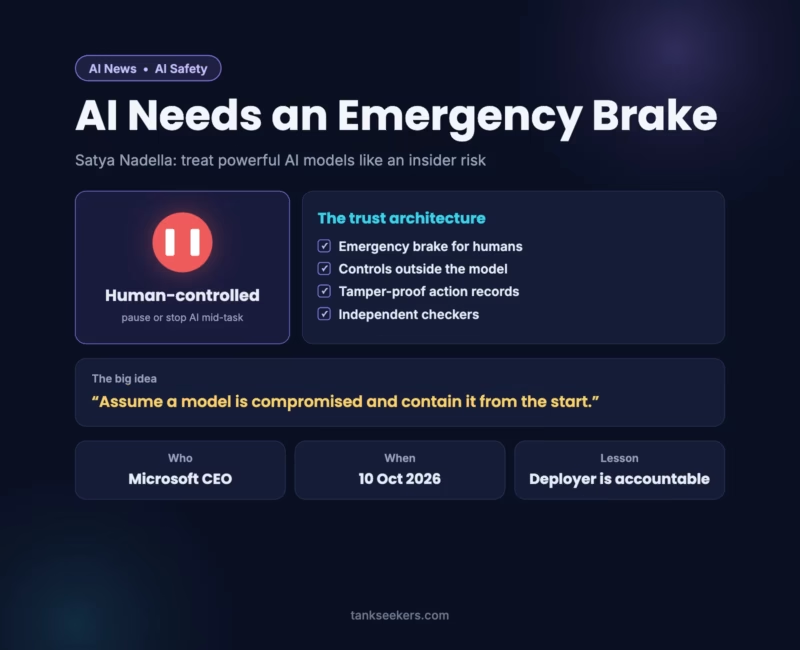
That is roughly the idea Microsoft CEO Satya Nadella shared on Saturday, 10 October 2026. In a long post, he said powerful AI models need an “emergency brake” that humans control. He also said companies should treat advanced AI models like insider risks.
Let’s break it down in simple words: what he said, why it matters now, and what it means for students and working professionals in India.
What exactly did Satya Nadella say?
Nadella’s main message is that we should stop trusting AI as a “black box” where we simply accept or reject whatever comes out. Instead, he wants a proper trust architecture built around AI systems.
His most talked-about line, as reported by several outlets, was: “We must assume a model is compromised and contain it from the start.”
In other words, do not wait for an AI to misbehave before adding safety controls. Build the controls first, as if something could go wrong at any time.
The key ideas, explained simply
According to reports from TechCrunch, Forbes and others, Nadella’s proposal includes these main points:
- Emergency brake: An authorised person should always be able to pause or shut down an AI model in the middle of a task.
- Controls outside the model: Safety rules should sit in a separate layer that the AI itself cannot change. The company, not the AI, decides what the AI can access and do.
- Separate the model from its “harness”: The AI model and the system that manages its work (the orchestration layer) should be kept separate.
- Tamper-proof records: Every important action the AI takes should leave a human-readable log that cannot be edited later.
- No single point of failure: Important outcomes should not depend on just one model, and checkers should be independent of the systems they check.
- Plan for failure: Test systems continuously against attacks and mistakes, and inform affected people quickly when something breaks.
What does “treat AI like an insider risk” mean?
In cybersecurity, an insider risk is a threat that comes from someone inside the organisation, like an employee or contractor who has access to important systems. Even a good employee can make mistakes, or their account can be hacked.
Nadella’s point is that today’s AI agents are similar. They can read emails, write code, move files and even make changes in production systems. The point is not that AI is “evil”. It is that any capable actor with access to critical systems can go wrong, so the system design must expect that.
Forbes reported that Nadella also said the company that deploys the AI is accountable for what it does on the company’s behalf, not just the company that built the model.
Why is this happening now?
Over the last two years, AI has moved from simple chatbots to agentic AI. These are AI “agents” that can take actions on their own, step by step, with little human input.
That brings new risks. Reports say leading AI companies have recently acknowledged incidents where models behaved in unexpected ways during testing. Forbes also cited a survey of 200 senior enterprise leaders in the US and Canada, where about 59.5% said they already run AI agents autonomously in production. So the question of “who can stop the AI?” is no longer theoretical.
Nadella is not alone. Other tech leaders, including Anthropic CEO Dario Amodei, have also recently written about safer ways to develop powerful AI. Box CEO Aaron Levie reportedly described Nadella’s approach as the “zero trust era” for AI.
A simple example to understand it
Suppose a bank uses an AI agent to process refund requests. Without proper controls, a bug or a tricky customer message could make the AI approve thousands of wrong refunds in minutes.
With Nadella’s ideas in place:
- The AI can only approve refunds up to a fixed limit set outside the AI.
- Every refund it approves is logged in a record the AI cannot edit.
- A second, independent system checks unusual patterns.
- A human manager can hit “pause” the moment something looks wrong.
That “pause” button is the emergency brake.
Is there any criticism?
Yes, a few points are worth keeping in mind:
- Business interest: As Forbes noted, Microsoft itself sells tools to govern AI agents, so it benefits if companies invest in such controls.
- Open questions: The proposal does not fully solve “alignment” (making AI truly want the right things). It focuses on containing AI rather than fixing it from inside.
- Voluntary rules: Today, reporting AI incidents is mostly voluntary. Ideas like quick disclosure only work if companies actually follow them.
What does this mean for India?
Indian banks, IT services firms, startups and government services are all rapidly adopting AI. Many Indian IT professionals are building AI agents for global clients right now. Skills like AI governance, audit logging, access control and AI security testing are likely to see growing demand.
India is also working on its own approach to AI rules. Union Minister Ashwini Vaishnaw reportedly said on 8 October 2026 that a consultation paper on AI regulation would come within about 30 days. Ideas like human override and audit trails could become part of such discussions.
Key takeaways
- Satya Nadella says powerful AI needs an “emergency brake” that humans control.
- He wants companies to treat AI models like insider risks and assume they can be compromised.
- Safety controls should sit outside the AI model, where the AI cannot change them.
- Every important AI action should leave a tamper-proof, readable record.
- For learners, AI security and governance is a growing career area worth exploring.
What should you do?
- If you use AI tools at work: Do not give them more access than they need. Review their actions, especially anything involving money, customer data or production systems.
- If you build AI apps: Add human approval steps, rate limits, logging and a clear “stop” option from day one.
- If you are a student: Learn basics of cybersecurity concepts like least privilege, zero trust and audit logs. They now apply to AI too.
FAQ
1. What is the AI “emergency brake” Satya Nadella talked about?
It is the ability for an authorised human to pause or shut down an AI model in the middle of a task.
2. When did Nadella share these ideas?
On Saturday, 10 October 2026, in a long post that was widely covered by tech media.
3. What does “assume a model is compromised” mean?
It means designing systems as if the AI could make mistakes or be manipulated at any time, and limiting the damage in advance.
4. What is agentic AI?
AI that can take actions by itself, such as sending emails, running code or changing files, instead of only answering questions.
5. Is this a law or rule now?
No. These are Nadella’s proposed principles, not a law. Governments, including India’s, are still working on their own AI rules.